Background and Motivation
Residual velocity of a projectile after high-velocity impact is a critical metric for evaluating ballistic resistance and for the design of multilayer protective structures. Classical residual velocity models are typically calibrated for specific impact scenarios and are difficult to generalize across variations in impact velocity, angle, and target thickness.
As a result, residual velocity data obtained from experiments and simulations are often discrete and fragmented, making it challenging to establish a unified and physically interpretable model that covers a wide range of impact conditions.
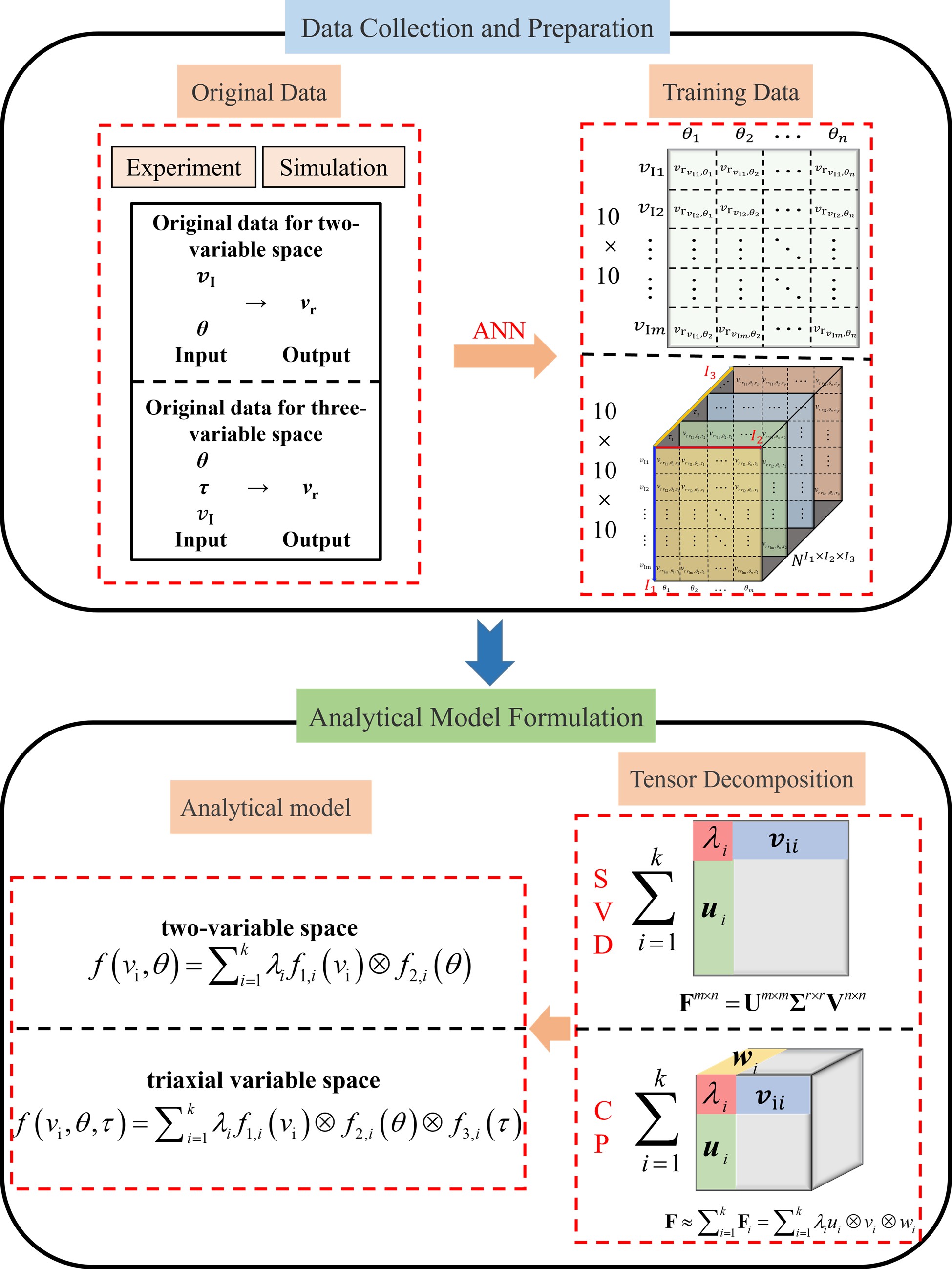
Motivated by these limitations, this work develops a hybrid experimental–numerical–machine learning framework to construct general residual velocity models in multi-variable space. By combining artificial neural networks with mathematical decomposition techniques, the study aims to extract decoupled and physically meaningful relationships between residual velocity and key impact parameters, enabling improved understanding and prediction of ballistic resistance.
Highlights
•
A residual velocity model involving multiple variables (impact velocity, impact angle and target thickness) is derived out from the mathematical decomposition and ANN combined method.
•
The decoupled relationships between the residual velocity (typical evaluation of ballistic resistance behavior) and the impact angle, target thickness, and initial velocity of the projectile are obtained respectively.
•
The decoupled components of the residual velocity model were interpretated with physical mechanisms involving material damage.
•
Two impact regions, i.e. perforating region and safe region, of a target are discovered by the proposed framework, which is critical to the design and understanding of the protective structures.
Source: Yunfei Deng, Yixu Lv, Xiaoyue Yang, Chunzhi Du, Xianglin Huang*, Determination of residual velocity model of finite thickness material based on Artificial Neural Network, Thin-Walled Structures, Volume 216, Part B, 2025, 113685, ISSN 0263-8231, https://doi.org/10.1016/j.tws.2025.113685.